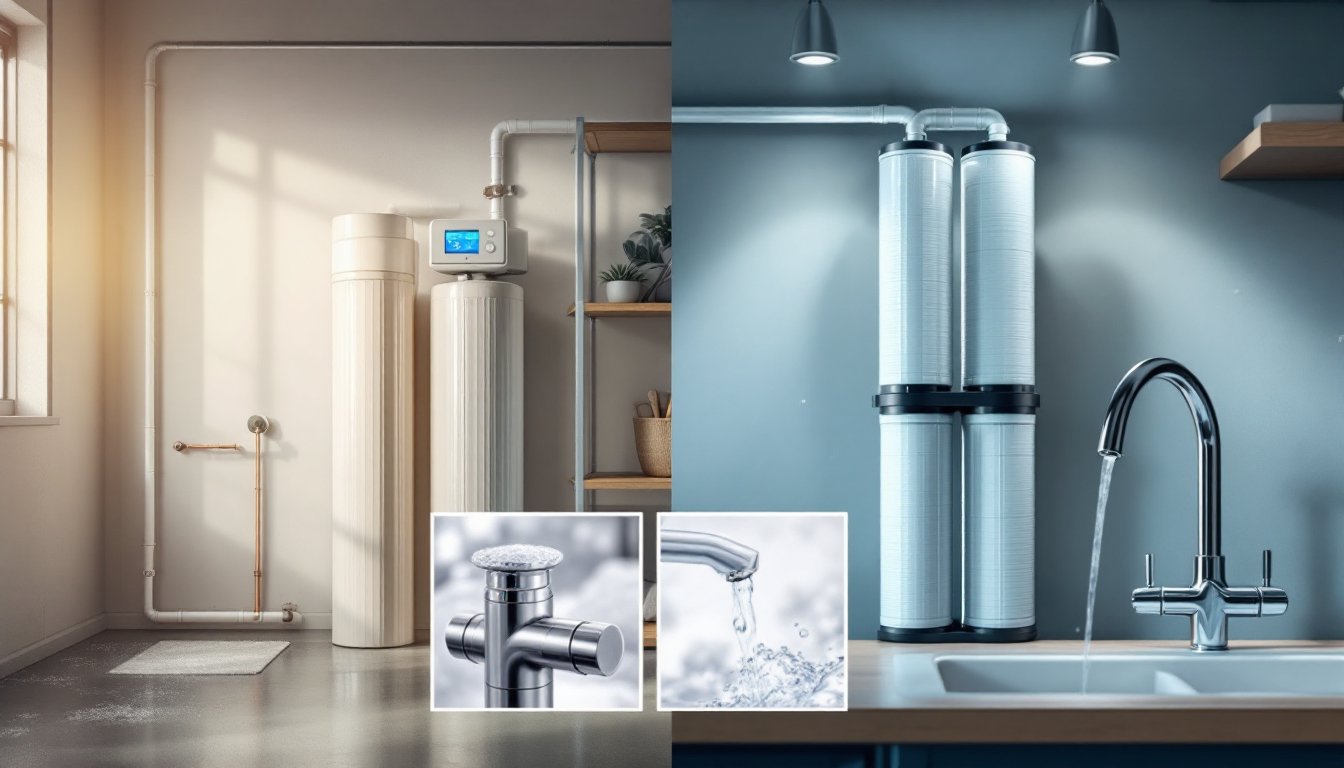

Most homeowners assume a water softener and a water filter do the same job. They don’t. One tackles mineral buildup: the other removes contaminants. Getting this wrong means spending money on a system that won’t solve your actual water problem. This guide breaks down the real difference between water softeners and filters, when you need each one (or both), and what’ll actually improve your home’s water quality without very costly.
Table of Contents
ToggleKey Takeaways
- Water softeners and water filters solve different problems: softeners remove minerals like calcium and magnesium causing hardness, while filters eliminate contaminants such as chlorine, sediment, and bacteria.
- A water softener vs filter decision depends on your symptoms—choose a softener if you see chalky buildup and notice poor soap lathering, or choose a filter if your water tastes off or smells like chlorine.
- Whole-house water softener systems cost $1,000–$3,000 installed with monthly maintenance around $15–$30, while whole-house filters range from $1,500–$3,500 with cartridge replacements every 6–12 months.
- Many homes benefit from using both systems together in sequence: sediment filter first, then softener, then optional activated carbon filter for maximum water quality protection.
- Get your water tested by your local health department or a certified lab before purchasing either system—testing is often free or under $200 and reveals exactly which contaminants or hardness levels you’re dealing with.
- A combined filtration and softening system costs $2,500–$5,000+ installed but is often more efficient than separate systems, especially if your home has both hard water and contamination issues.
Understanding The Key Differences
The confusion makes sense: both systems improve water quality, but they work in completely different ways.
A water softener removes mineral ions, primarily calcium and magnesium, that make water “hard.” Hard water leaves chalky residue on shower doors, clogs pipes over time, and makes soap less effective. A softener uses ion exchange, swapping those minerals for sodium (or potassium) to prevent buildup.
A water filter removes contaminants: chlorine, sediment, bacteria, cysts, and sometimes even certain chemicals or taste/odor issues. Filters work through physical barriers (mesh, cartridges) or chemical absorption (activated carbon). They don’t address hardness at all.
Here’s the practical takeaway: if your water feels slippery and leaves white buildup, you have hard water, you need a softener. If your water tastes or smells off, or you’re concerned about chlorine or sediment, you need a filter. These are separate problems with separate solutions.
Water Softeners: What They Do and When to Use Them
A water softener system works by running hard water through a resin bed packed with tiny beads. The calcium and magnesium ions stick to those beads, and sodium ions take their place. Once saturated, the resin regenerates using a salt brine solution, washing away the minerals and restoring the beads.
When you need a softener:
• Your water hardness exceeds 60 ppm (parts per million), measured in gpg (grains per gallon)
• You see white, crusty buildup on faucets, showerheads, or inside pipes
• Soap doesn’t lather well: your skin or hair feels sticky after showering
• Your water heater runs less efficiently or fails prematurely
• You have concerns about scale damage to appliances (dishwashers, washing machines)
Typical whole-house systems cost $1,000–$3,000 installed, though simpler models run $300–$800. Monthly water and electricity costs usually total $15–$30, depending on your hardness and usage. Point-of-use softeners (kitchen tap or shower only) cost less upfront but don’t protect pipes and appliances.
Note: Softeners add sodium to your water, usually 50–100 mg per quart. If you’re on a sodium-restricted diet or serve a large household, discuss this with your doctor or consider potassium-based systems (pricier but sodium-free).
Water Filters: Purpose, Types, and Effectiveness
Water filters come in several flavors, each targeting different contaminants.
Common filter types:
• Activated carbon filters remove chlorine, odor, taste, and some chemicals. They’re affordable ($20–$100 per cartridge) but won’t touch minerals or bacteria without additional steps.
• Sediment filters catch particles like sand, rust, or silt. Useful if your water’s visibly cloudy but ineffective against dissolved chemicals.
• Reverse osmosis (RO) systems force water through a semi-permeable membrane, removing nearly everything, minerals, bacteria, viruses, heavy metals. Point-of-use RO units cost $200–$500 and produce filtered water slowly. Whole-house RO is expensive and wastes significant water.
• Pitcher and faucet-mounted filters (like Brita or PUR) remove chlorine and improve taste for drinking water only. Dirt cheap but limited range.
• Whole-house filtration systems use combinations of the above, protecting all outlets. Prices range from $1,500–$3,500 installed depending on complexity.
If you get your water from a municipal source, it’s already treated and tested. A carbon filter (pitcher, faucet, or whole-house) typically handles chlorine and taste. Well water requires testing first, bacteria, nitrates, or arsenic need specific filters.
Some homeowners benefit from shower filters as a cost-effective alternative for specific concerns: the best shower filters for hard water and dry skin can address chlorine and mineral exposure without a full-house system.
Cost Comparison: Installation and Ongoing Maintenance
Budget matters. Here’s a realistic breakdown:
Water Softener:
• Whole-house system: $1,000–$3,000 installed
• Monthly salt or regenerant: $10–$20
• Replacement resin (every 10–15 years): $200–$400
• Water waste during regeneration: ~5 gallons per cycle
Water Filter (Whole-House):
• System cost: $1,500–$3,500 installed
• Cartridge replacements (every 6–12 months): $50–$200 per cartridge
• No water waste: no salt purchasing
Point-of-Use Options (Cheaper Upfront):
• Pitcher filters: $25–$50 per pitcher, cartridges $10–$15 every 2 months
• Faucet or shower filters: $30–$100 per unit, cartridges $15–$30 yearly
• Kitchen RO unit: $200–$500, filters $75–$150 annually
If you have moderate hard water but municipal water quality concerns, a water filter vs water softener comparison shows that a whole-house filter might be the better first investment. If hardness is severe and you also want chlorine removal, you’ll eventually need both, and that combined cost justifies planning accordingly.
Signs Your Home Needs One or Both Systems
Testing pinpoints the answer. Get your water tested by your local health department (often free) or a certified lab ($100–$200).
Symptoms pointing to hard water (softener needed):
• White, chalky residue around sink aerators or inside kettle
• Soap scum on tub walls: shampoo doesn’t lather
• Stiff, dull laundry: colors fade faster
• Reduced water pressure from scale buildup in pipes
• Water heater makes popping or rumbling sounds
Symptoms pointing to filtration issues (filter needed):
• Water tastes metallic, musty, or off
• Visible cloudiness or discoloration
• Chlorine smell from tap water
• Well water with bacteria or sediment concerns
• Recent pipe breaks or water main work in your neighborhood
If you’re seeing chalky buildup and noticing taste or odor issues, you likely need both. This is especially common in older homes with galvanized pipes that shed particles and hard water that accelerates corrosion. Resources like Family Handyman plumbing fixes offer step-by-step guidance for diagnosing water issues before you invest in a system.
Can You Use Them Together?
Absolutely, and sometimes you should. A typical two-stage setup runs water through the filter first (catching sediment and chlorine), then through the softener (removing hardness). This protects the softener’s resin bed from sediment damage and gives you clean, soft water throughout the house.
Order matters:
- Sediment filter (removes particles, extends downstream filter life)
- Softener (removes hardness)
- Activated carbon filter (polishes taste and odor, optional)
Some systems combine filtration and softening in a single unit, though they’re typically smaller and better for apartments or condos than whole-house use. Whole-house systems are more efficient when stacked separately because you can size each component to your needs.
The investment? Plan $2,500–$5,000+ for a combined system installed. It sounds steep, but if both problems exist, treating them separately costs roughly the same and adds complexity. Smart home reviews and buying guides sometimes cover integrated water systems if you’re exploring tech-enabled softeners with monitoring.
Can a water softener also filter water? Not really, it addresses hardness, not contaminants. Does water softener filter water? No: softening and filtering are separate processes. A softener won’t remove chlorine, bacteria, or sediment. If you’ve been assuming your softener handles everything, it’s worth testing your water to confirm what you’re actually getting.
Conclusion
The answer to water filter or water softener depends entirely on your water problem. Test first, then buy. Hardness and contamination are different issues: confusing them wastes money and leaves problems unsolved. Many homes benefit from both, installed in sequence. Work with a certified water specialist if you’re unsure, it costs nothing to talk it through, and you’ll avoid costly mistakes down the road.